Refinery-corridor air and older masonry: what decades near Martinez and Pittsburg do to a chimney
The Carquinez Strait corridor through Martinez and Pittsburg has hosted heavy petrochemical industry for over a century, and the region’s air quality restrictions apply countywide. Here is what long-term exposure to industrial air actually does to a masonry chimney, separate from ordinary weathering.
Published
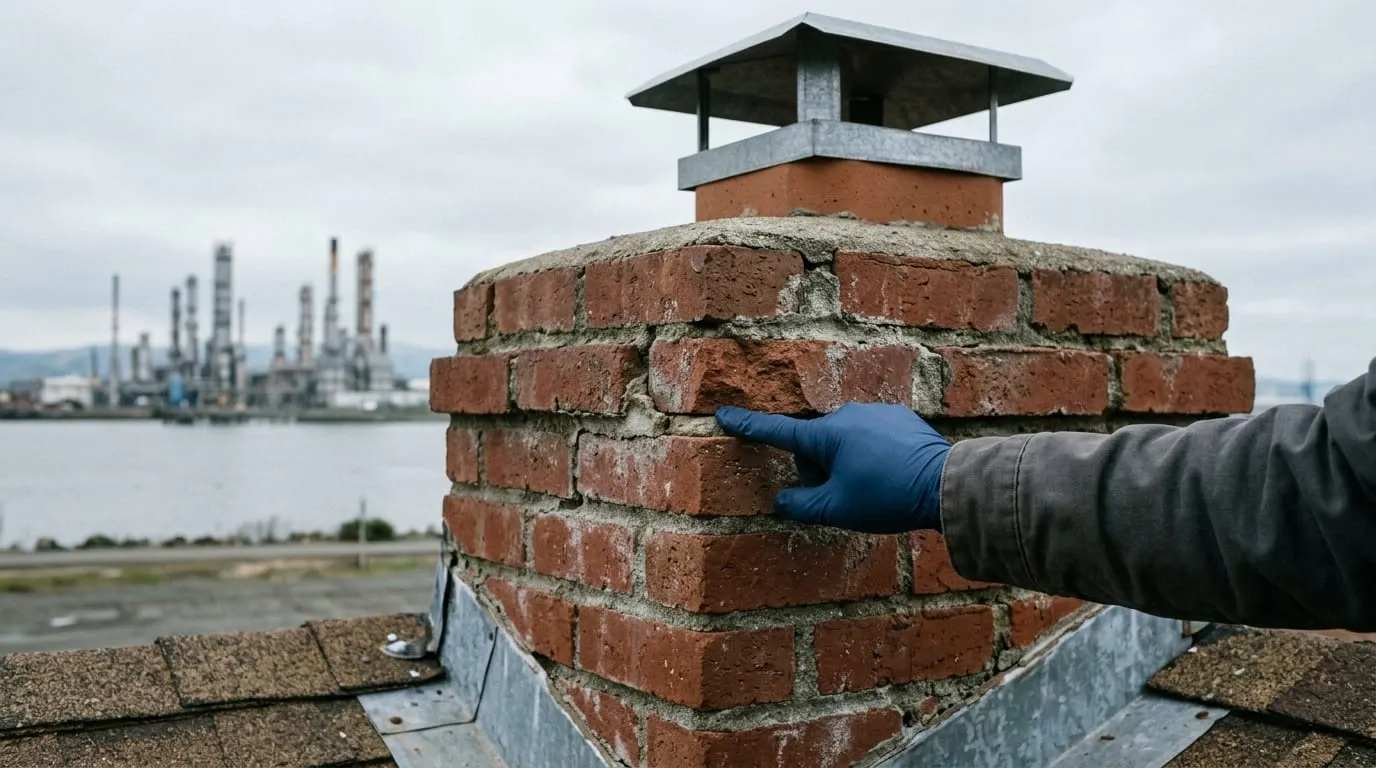
Martinez and Pittsburg’s older cores, along the Carquinez Strait, carry some of the oldest housing stock in Contra Costa County — much of it built before or shortly after the petrochemical industry that still lines the waterfront today first arrived in the early 1900s. That combination of age and proximity to over a century of industrial air is not something the rest of the county’s chimneys have had to weather in the same way, and it is worth understanding on its own terms rather than folding it into a generic “old chimney” conversation.
Industrial air is a slow, chemical kind of weathering
Ordinary weathering on masonry is mostly mechanical and thermal: rain, freeze-thaw cycling, and Diablo Valley’s hot summers baking a crown until it cracks. Air carrying industrial particulates and emissions adds a different, slower mechanism on top of that: fine particulates and airborne compounds can settle into porous mortar and brick surfaces over years, contributing to surface deterioration that looks similar to ordinary age-related wear but that started from a different cause and can progress somewhat faster on the specific surfaces most exposed to prevailing wind off the strait.
Why the region’s air-quality rules apply countywide, not just locally
The Bay Area Air Quality Management District’s “Spare the Air” wood-burning restrictions, which can limit fireplace and wood-stove use on days when air quality drops, apply across the whole of Contra Costa County — not only in Martinez and Pittsburg. What makes the refinery corridor specific is that its baseline air quality already carries an industrial component the rest of the county’s air does not, on top of whatever wildfire smoke or wintertime stagnation triggers a Spare the Air day elsewhere. A restricted-burn day here is layering onto air that was already different than in central Concord.
What this means for an inspection on an older waterfront-corridor home
On a genuinely old masonry chimney in this corridor — a home built in the early-to-mid 1900s, common closer to Martinez’s historic waterfront core — an inspection looks at mortar surface condition with a bit more attention than the same check would need further from the industrial corridor, since the combination of age and long-term air exposure can mean surface deterioration is a little further along than a chimney’s visible age alone would suggest. This is not a reason to assume a problem exists — it is a reason to actually look rather than estimate from a distance.
It is not a reason to avoid an older Martinez or Pittsburg property
None of this means an older home in this corridor is a poor choice or that its chimney is automatically compromised. Plenty of century-old masonry along the strait has been properly maintained and remains entirely sound — brick and mortar built before modern building codes were often built to a standard that has genuinely held up. The point is narrower: the maintenance interval that keeps a chimney sound in this specific environment may reasonably be a little shorter than the interval that works fine for a newer structure further from the corridor, and a first inspection on a property with unknown history is worth treating as a genuine baseline check rather than a formality.
What we actually check differently here
Beyond the standard sweep or inspection scope, a visit to an older property in the refinery corridor includes closer attention to mortar surface condition on wind-exposed faces of the stack, and — for a chimney with genuinely unknown service history — a Level 2 camera inspection is often the more useful starting point than a Level 1 visual check alone, simply because it gives an actual baseline rather than an estimate.
Booking a check in Martinez, Pittsburg or the Carquinez corridor
If your property is older construction along the waterfront corridor and there is no record of the chimney ever having been properly inspected, that is a reasonable thing to schedule as a baseline, independent of whether anything currently looks wrong from the ground.
Read next
More from the blog
The BART-era building boom and what it means for a 1970s Contra Costa chimney
BART reached central Contra Costa County in 1973 and turned a string of towns into commuter suburbs almost overnight, with tract housing built quickly to match. A lot of that housing carries factory-built metal chimneys rather than original masonry, and they age in a completely different way.
What a Contra Costa home sale actually requires from a chimney inspection
Contra Costa County’s active housing market — from Diablo Valley starter homes to San Ramon Valley move-up buyers — puts a chimney inspection request in front of a lot of sellers and buyers every month. Here is what the request usually means, and what level of inspection actually answers it.
Delta humidity, ag dust and what they do to flashing in eastern Contra Costa
The Delta edge of Contra Costa County — Antioch, Pittsburg, Brentwood — runs a noticeably different air pattern from the Diablo Valley core: more humidity swing, more wind-carried dust off surrounding farmland. Here is how that combination specifically wears on a chimney’s flashing seams.
Get a baseline inspection
Tell us the age of the property — we will tell you plainly what level of check actually fits.