Delta humidity, ag dust and what they do to flashing in eastern Contra Costa
The Delta edge of Contra Costa County — Antioch, Pittsburg, Brentwood — runs a noticeably different air pattern from the Diablo Valley core: more humidity swing, more wind-carried dust off surrounding farmland. Here is how that combination specifically wears on a chimney’s flashing seams.
Published
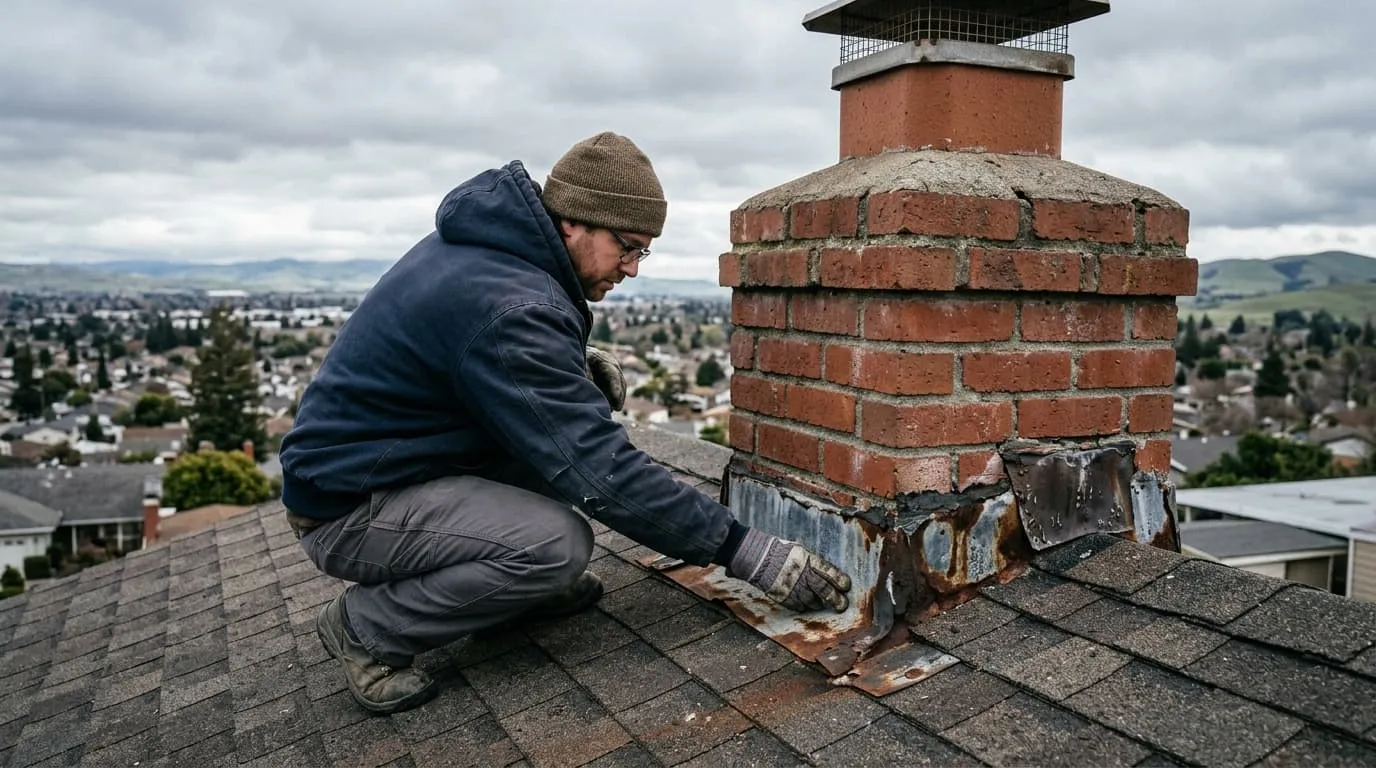
Contra Costa County is not one climate. Central Concord and Walnut Creek sit in the Diablo Valley’s more sheltered heat pattern, while further east — Antioch, Pittsburg, Oakley and Brentwood — the land opens toward the Sacramento-San Joaquin Delta, and the air behaves differently. Humidity swings more sharply between the marine layer pushing inland overnight and dry daytime heat, and steady wind off the surrounding agricultural land carries a level of fine dust that the more built-up Diablo Valley core simply does not see as much of. Both of those things land squarely on one component: the flashing where a chimney meets the roof.
Why flashing is the seam that takes the hit
Flashing is the metal seal at the joint between the chimney and the roofline — usually step flashing woven into the shingle courses, sometimes a continuous piece depending on the roof type. Its whole job is to stay tight against two surfaces that expand and contract at different rates, in different materials, without ever opening a gap. That is a harder job in a climate that swings between damp overnight air and dry, dusty daytime heat than it is somewhere with a steadier, more moderate pattern.
The humidity swing specifically
Delta-adjacent mornings often carry noticeably more moisture than a Concord or Walnut Creek morning does, even on days that end up equally hot by afternoon. That daily swing between damp and dry puts flashing metal through a small expansion-contraction cycle every single day, not just seasonally the way crown cracking from summer heat does. Over years, that daily cycling is what works a flashing seam loose at the fasteners or the sealant line, well before the metal itself would otherwise be due for replacement.
What agricultural dust actually does
Wind carrying fine dust off surrounding farmland is mostly a nuisance for anyone with allergies, but it has a real physical effect on a roof too: dust settles into any gap or seam and, combined with the area’s humidity swings, can hold moisture against a flashing seam longer than a clean, dust-free seam would experience. It is a small effect on any single day and a cumulative one over a few dry seasons — one more reason flashing on an Antioch, Pittsburg or Brentwood property tends to show wear a little earlier than the same-age flashing further west in the county.
Why this often gets mistaken for a crown problem
A water stain near the chimney reads the same to a homeowner whether it started at a cracked crown or a failed flashing seam, and in the Delta corridor specifically, flashing is worth checking first rather than assuming crown damage is the default cause the way it more often is in the drier Diablo Valley core. We check both on every repair visit, in the order the damage would actually have started, rather than defaulting to whichever fix is more familiar.
What a proper flashing check involves
Because flashing failure here is often gradual — daily cycling rather than one dramatic event — a visual check from the roof is not always enough on its own. We look at the seam itself for lifted edges, corrosion at fastener points, and any place sealant has cracked or pulled away, and we check the roofing material immediately around the flashing for signs that water has already been finding a path around rather than over it.
What changes the scope of a flashing repair
A flashing seam caught with early lifting or minor corrosion is usually a straightforward reseal or a section replacement. A seam that has been failing unnoticed for a season or more, letting water reach the decking or the masonry beneath, is a larger job — not because the flashing itself got harder to fix, but because whatever it was protecting has now been exposed longer. That gap in scope is exactly why catching it early matters more in this corridor than in a milder, steadier climate.
Booking a check in Antioch, Pittsburg or Brentwood
For a property on the Delta side of the county where nobody’s checked the flashing itself in over a year — separate from just the fireplace indoors — scheduling that ahead of the rainy season is a reasonable call, especially with visible dust built up around the base of the chimney.
Read next
More from the blog
The BART-era building boom and what it means for a 1970s Contra Costa chimney
BART reached central Contra Costa County in 1973 and turned a string of towns into commuter suburbs almost overnight, with tract housing built quickly to match. A lot of that housing carries factory-built metal chimneys rather than original masonry, and they age in a completely different way.
What a Contra Costa home sale actually requires from a chimney inspection
Contra Costa County’s active housing market — from Diablo Valley starter homes to San Ramon Valley move-up buyers — puts a chimney inspection request in front of a lot of sellers and buyers every month. Here is what the request usually means, and what level of inspection actually answers it.
Diablo winds, ember risk, and what a chimney cap actually has to survive
Diablo winds are Contra Costa County’s defining fall fire-weather event — hot, dry, offshore gusts that test a chimney cap’s mesh in a way still air never does. Here is what actually fails, and why the fix is usually the cheapest part on the chimney.
Get the flashing checked before the rains
Walk us through what you’ve spotted and we’ll come back with a written scope, not a guess.